How Americans are Using Solar Investment Tax Credits To Cut Tax Bills Nearly in Half In 2026 and Beyond.

Offset both income AND capital gains taxes using the same strategy Fortune 500 companies have used for decades—now accessible to high-net-worth individuals.

We help educate and guide clients on tax credit programs and tax efficiency more broadly.

SCHEDULE YOUR SOLAR STRATEGY CALL
For informational purposes only. Not investment, tax, or financial advice.

Are You?

A High-Net-Worth Individual or Business Owner...

  • Facing a $200K+ tax bill from W-2 income, business profits, stock sales, crypto gains, or real estate exits?

  • Frustrated that most tax strategies only address income tax but leave your capital gains fully exposed?

  • Watching Fortune 500 companies slash their tax bills while your CPA tells you "there's nothing we can do"?

  • Looking for a proven, legal tax reduction strategy backed by decades of IRS precedent?

Learn More

If you're facing $200K to $200M in tax liability over the next few years.

We'll show you exactly how Solar ITC works.

Get Started

The Strategy

The Wealthy's Secret to Slashing Income AND Capital Gains Taxes

The US government offers extraordinary tax incentives to anyone who finances solar panel installations on residential properties.

Here's why this matters to you:

The Government's Problem

America wants to reduce its carbon footprint and transition to clean energy. But solar panels cost $15,000-$40,000 per home—far beyond what most Americans can afford upfront.

The Government's Solution

Congress created massive tax incentives for investors who finance solar installations on other people's homes. These aren't loopholes or gray areas. They're explicit government policy designed to accelerate residential solar adoption.

Your Opportunity

When you invest in qualified solar projects that install panels on American homes, you receive:

How This Actually Works

The Basic Structure
Instead of installing solar panels on your own home, you invest as a limited partner in a solar project that installs panels on multiple residential properties.

The solar company handles all installation, maintenance, and customer relationships.

You receive tax benefits proportional to your investment.

Think of it like investing in commercial real estate, but instead of owning buildings, you own a share of solar energy infrastructure installed on homes across America.

The homeowners get affordable clean energy, you get substantial tax credits and cash flow, and the environment benefits.
Why This Offsets BOTH Income and Capital Gains
Most tax strategies only work on one type of tax. Real estate depreciation typically only offsets passive income.

1031 exchanges only defer capital gains, not eliminate them. Charitable giving reduces ordinary income but doesn't help with investment gains.

Solar ITCs are different.

They're dollar-for-dollar credits against your total federal tax liability—whether that tax comes from W-2 income, business profits, stock sales, crypto gains, or real estate exits.

If you owe $500,000 in taxes and generate $500,000 in solar credits, your tax bill goes to zero.
Who Handles the Work?
You don't install or maintain anything.

Professional solar developers are hired to handle project development, equipment procurement, installation, monitoring, and ongoing maintenance.

Homeowners sign agreements for the solar panels on their roofs.

You invest the capital, oversee the business, and receive tax benefits plus ongoing distributions from selling the power.

Act Now

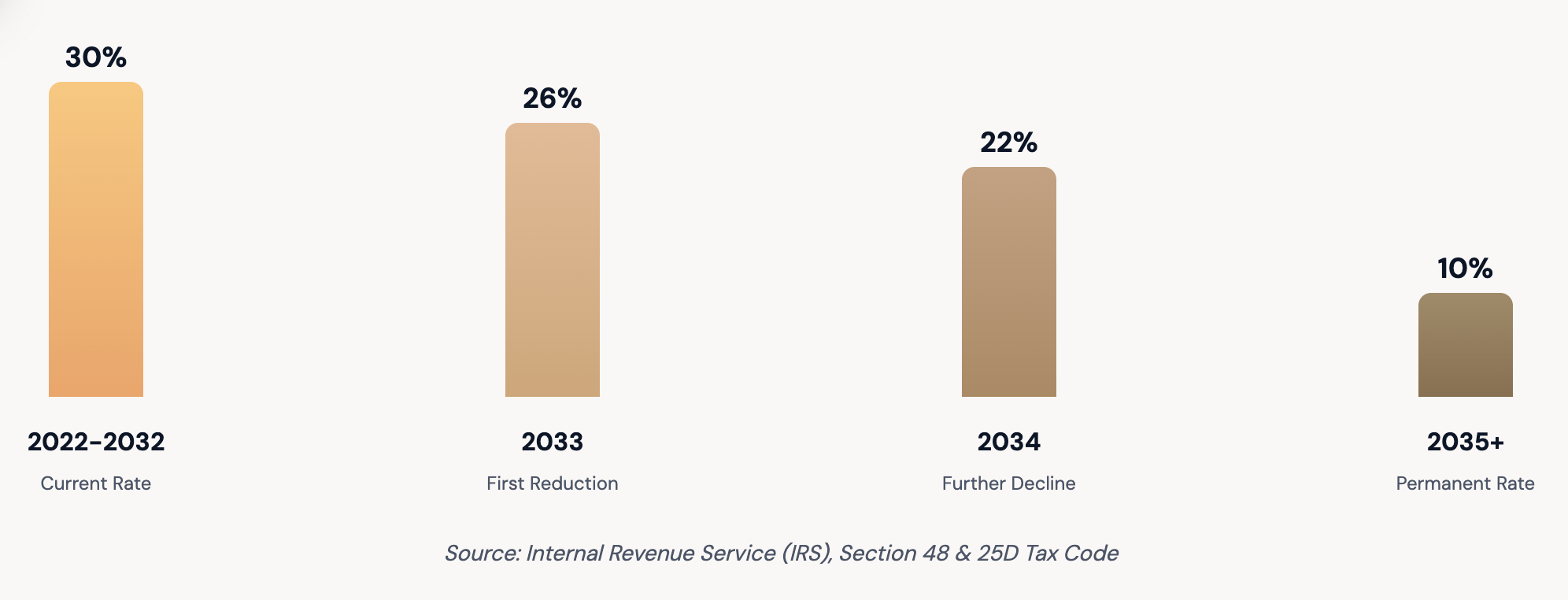
Federal Solar ITC Phase-Down Schedule

Lock in the full 30% tax credit while it's available. The credit decreases significantly after 2032.

This Is "Black-Letter Law"—Not a Loophole

"This sounds too good to be true."

Recent Changes Make This BETTER

The Big Beautiful Bill (2025) phased out credits for solar on your own home, but INCREASED incentives for residential solar projects financed and operated by third-party investors, with bonus credits for projects in low-income communities, and if materials are mostly made in America.
  • Energy Tax Act of 1978

    Solar tax credits originated, establishing the foundation for renewable energy incentives

  • Energy Policy Act of 2005

    Significant expansion of solar tax credits, making them more accessible and valuable

  • Inflation Reduction Act of 2022

    Supercharged incentives with enhanced credits and extended timelines

  • Today: $50+ Billion Annual Market

    Used by GE, Google, Apple, and thousands of institutional investors

Time-Sensitive Opportunity

Don't Leave Millions in Tax Savings on the Table

Solar ITC strategies are much easier with advanced planning and proper structuring. The sooner you start, the more you can optimize your specific tax situation.
Current Year Tax Reduction
Must invest by December 12th to offset this year's tax bill
Works in 2026 and 2027 Too
Credits remain at 30% through 2032, giving you multiple years to plan and invest.
Legislative Window
Enhanced credits begin phasing down after 2032—act while benefits are maximized. Clients have dramatically reduced their tax bills. The government is happy the carbon footprint is reducing. The homeowners are happy they're saving on their electric bills. Win-win-win.
Schedule Your Confidential Strategy Call Now